 The Human Ascent
Longevity of states and governments
Each country has two clocks: State age (continuity of the polity) and Current government age (measured from the last clear break: a new constitution, revolution, independence or regime change). Monarchies carry separate house/dynasty and constitutional-order dates.
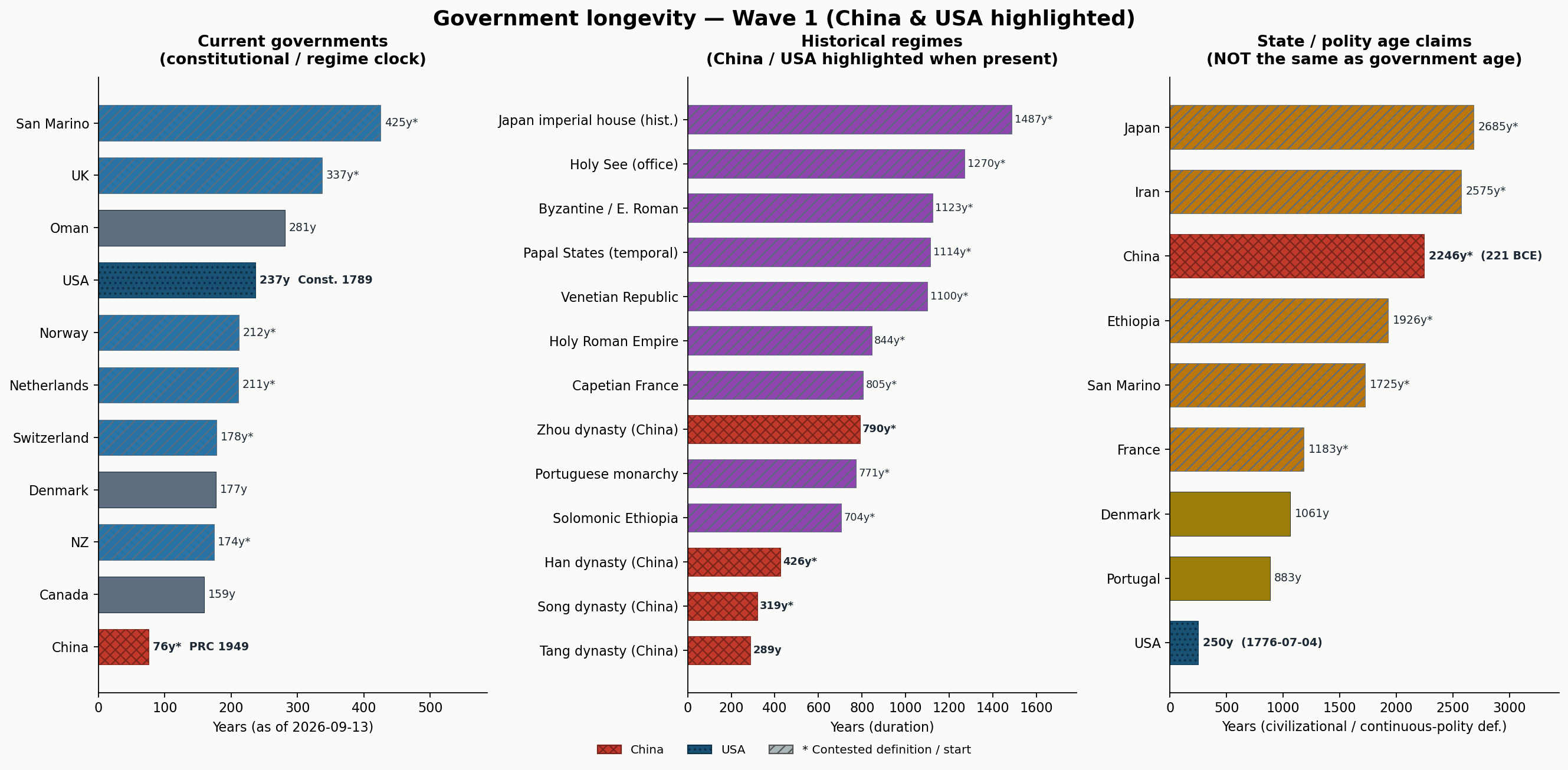
Current states: two clocks
Longest-lasting historical regimes
Duration rule: end_year - start_year (BCE: |start|+end if crossing era; no year 0). Ongoing uses 2026.
regime/government continuity vs civilizational/state continuity — see notes and contested flags (reference date 2026-09-13)
| Regime | Polity | Start | End | Years | How it ended | Type | Confidence | Notes & sources |
|---|
Download: countries_current.csv · regimes_historical.csv
Methodology & caveats
Methodology — Government & State Longevity
Reference date for ages: 2026-09-13 (America/Chicago). Ages = calendar years from start date to this date (integer floor of year difference unless noted).
Two clocks (always label which)
1. State / polity continuity (state_start)
When a continuous country/polity is treated as existing under a chosen definition. Common definitions (pick one per row; document in state_def):
- Independence / modern sovereignty — date of recognized independence or UN membership path.
- Continuous polity — uninterrupted institutional identity of the state even through dynasty/regime change (e.g. “China as a continuous state,” “Iran/Persia,” “Ethiopia”).
- Union / foundation — e.g. UK Act of Union 1707; USA Declaration 1776 vs Constitution 1789 (use notes).
Contested cases must carry alternate dates in notes and contested=true.
2. Government / regime continuity (current_gov_start)
When the current constitutional order, dynasty-as-ruling-system, or clear regime began — since the last clear rupture:
- Revolution that replaces the constitutional order
- Foreign occupation that resets sovereignty then new founding
- Coup + new constitution that breaks legal continuity
- Abolition of monarchy / founding of republic (or reverse)
- Unification that creates a new state identity
Not counted as rupture by default (flag if debate): peaceful constitutional amendment, succession within same dynasty under same order, party change via election, name change of ruling party without constitutional break.
Dual tracks for monarchies
Where relevant, record both:
dynasty_or_house_start— continuous reigning house (e.g. Japanese imperial house)constitutional_order_start— current constitution / Meiji / postwar order
Primary current_gov_start for ranking “government lasted” defaults to constitutional/regime order, with house continuity as a separate ranked series.
Scope
- All UN member states
- Non-UN flagged: Taiwan, Vatican City / Holy See, Kosovo, Palestine, Western Sahara, Cook Islands, Niue, etc.
- Historical regimes table is global, not limited to current states
Evidence rules
- Every date needs a citation in
sources(URL or standard reference) - Never invent dates; if unknown →
uncertain+ blank or range - Prefer primary texts (constitutions, treaties) and standard reference works (CIA World Factbook, Britannica, national archives, UN)
- Mark
confidence: high | medium | low
Ranking outputs
- Longest current governments/regimes (constitutional order)
- Longest current dynastic/house continuity (separate)
- Longest historical governments/regimes ever (ended or ongoing)
- Longest states under each state_def (independence vs continuous polity)
Known contested seeds (wave-1 focus)
Japan, San Marino, UK, Ethiopia, Iran, China, Vatican/Holy See, Andorra, Liechtenstein, Monaco, Switzerland, USA, Sweden, Denmark, Oman, Bhutan, Tonga, Thailand.
Data schema
Dataset schema
countries_current.csv / .json
| field | type | meaning | |||||
|---|---|---|---|---|---|---|---|
| iso3 | string | ISO 3166-1 alpha-3 or custom code (TWN, VAT, XKX, …) | |||||
| name | string | common English name | |||||
| un_member | bool | ||||||
| state_start | date YYYY-MM-DD or YYYY | ||||||
| state_def | string | independence \ | continuous_polity \ | union \ | other | ||
| state_age_years | int | as of 2026-09-13 | |||||
| current_gov_start | date | ||||||
| current_gov_age_years | int | ||||||
| gov_type | string | constitutional_monarchy \ | absolute_monarchy \ | republic \ | theocracy \ | one_party \ | other |
| dynasty_or_house_start | date/empty | optional dual track | |||||
| constitutional_order_start | date/empty | optional dual track | |||||
| contested | bool | ||||||
| confidence | high\ | medium\ | low | ||||
| notes | string | ||||||
| sources | string | semicolon-separated citations |
regimes_historical.csv / .json
| field | meaning |
|---|---|
| regime_name | e.g. Venetian Republic, Tokugawa shogunate |
| polity | geographic/political parent |
| start | |
| end | empty if ongoing |
| duration_years | |
| rupture_end | how it ended |
| gov_type | |
| contested | |
| confidence | |
| notes | |
| sources |
Wave 1 overview
Wave-1 overview — Government & state longevity
Reference date: 2026-09-13 Coverage: 42 seed entities (current) + 51 historical regimes Always two clocks: state/polity age ≠ government/regime age. Monarchies often need a third: house continuity.
Files
| Path | What |
|---|---|
data/countries_current.csv / .json | Current seed table |
data/regimes_historical.csv / .json | Historical regimes |
library/wave1_current_notes.md | Per-country contested alts |
library/wave1_historical_notes.md | Historical source notes |
synthesis/methodology.md | Definitions |
synthesis/wave1_longest_historical.md | Full historical top-25 |
index/sources_catalog.md | Citations |
---
A. Longest current governments (constitutional / regime clock)
| Rank | Country | Start | Age (y) | Contested? | Note |
|---|---|---|---|---|---|
| 1 | San Marino | 1600-10-08 | 425 | yes | Statutes of 1600 still foundational (alt: 301 / 885 / ~13th c.) |
| 2 | United Kingdom | 1689-02-13 | 337 | yes | Bill of Rights / Glorious Revolution settlement |
| 3 | Oman | 1744-11-20 | 281 | no | Al Said dynasty = regime |
| 4 | United States | 1789-03-04 | 237 | no | Constitution in force |
| 5 | Norway | 1814-05-17 | 212 | yes | Eidsvoll constitution continuous through 1905 independence |
| 6 | Netherlands | 1815-03-16 | 211 | yes | Kingdom; 1848 liberal constitution is dual-field |
| 7 | Switzerland | 1848-09-12 | 178 | yes | Modern federal order (1291 is state narrative) |
| 8 | Denmark | 1849-06-05 | 177 | no | Constitutional monarchy |
| 9 | New Zealand | 1852 | 174 | yes | Uncodified; alt 1907 / 1947 |
| 10 | Canada | 1867-07-01 | 159 | no | Confederation |
Takeaway: Among working governments, the leaders are early-modern constitutional settlements and a few long monarchies — not ancient civilizational labels. Japan’s government clock is only 79 years (1947 constitution) despite millennia of house claims.
---
B. Dual-track: longest reigning houses (separate series)
| Rank | Country | House start | ~Age (y) | Current gov age | Gap |
|---|---|---|---|---|---|
| 1 | Japan | 660 BCE trad. (Kinmei ~539 CE safer) | ~2685 (trad.) / ~1487 (hist.) | 79 | huge |
| 2 | Monaco (Grimaldi) | 1419 | ~607 | 63 | huge |
| 3 | Morocco (Alaouite) | 1666 | ~360 | 70 | large |
| 4 | UK (Hanover→Windsor) | 1714 | ~312 | 337 | house < constitution |
| 5 | Liechtenstein | 1719 | ~307 | 104 | large |
| 6 | Saudi / Oman roots | 1744 | ~281–282 | 93 / 281 | mixed |
| 7 | Thailand (Chakri) | 1782 | ~244 | 94 | large |
House longevity ≠ government longevity. Rank them separately or you get category errors.
---
C. Longest states in seed (civilizational / continuous-polity defs — highly contested)
| Rank | Country | State start used | Age (y) | Definition flavor |
|---|---|---|---|---|
| 1 | Japan | 660 BCE trad. | 2685 | traditional founding |
| 2 | Iran | 550 BCE | 2575 | Achaemenid / Persian polity |
| 3 | China | 221 BCE | 2246 | Qin unification |
| 4 | Ethiopia | ~1st c. | 1926 | Aksumite coalescence |
| 5 | San Marino | 301 | 1725 | traditional republic |
These are not “governments lasted X millennia.” Current regimes: Iran 1979, China PRC 1949, Ethiopia FDRE 1995.
---
D. Longest historical regimes ever (preferred scholarly starts)
| Rank | Regime | Span | Years | Caveat |
|---|---|---|---|---|
| 1 | Japanese Imperial House (hist. from ~539) | ongoing | 1487 | dynasty, not continuous government |
| 2 | Holy See (from ~756 marker) | ongoing | 1270 | office/personality; contested |
| 3 | Byzantine / E. Roman | 330–1453 | 1123 | start date debated |
| 4 | Papal States (temporal) | 756–1870 | 1114 | |
| 5 | Venetian Republic | 697–1797 | 1100 | 697 traditional |
| 6 | Holy Roman Empire | 962–1806 | 844 | weak unitary gov; alt 800 |
| 7 | Capetian France | 987–1792 | 805 | house continuity |
| 8 | Zhou (dynastic label) | 1046–256 BCE | 790 | demote as unitary regime |
| 9 | Portuguese monarchy | 1139–1910 | 771 | |
| 10 | Solomonic Ethiopia | 1270–1974 | 704 | interruptions debated |
Full top-25 + near misses: synthesis/wave1_longest_historical.md.
---
E. Answer to “which governments have actually lasted longest?”
Strict current constitutional/regime order: San Marino (~425), UK (~337), Oman (~281), USA (~237), Norway (~212)…
Longest historical governing institutions (not just houses): Venice (~1100), Byzantium (~1123), Papal States (~1114), HRE (~844), Ottoman (~623), Joseon (~518)…
Longest continuous houses: Japan (historical ~1487+), then European microstate/Maghreb houses on the order of centuries.
Do not mix Qin China or Aksum Ethiopia into the “government lasted” ranking — those are state/civilization clocks.
---
F. Next waves
- Expand
countries_currentto all UN members + remaining flagged non-UN. - Normalize confidence / alternate-date columns.
- Publish sortable ranked CSVs:
rank_current_gov.csv,rank_historical_regimes.csv,rank_houses.csv. - Deep-dive notes for San Marino, UK, Oman, Japan dual-track, Holy See.
Longest historical regimes — analysis
Wave 1 synthesis — Longest historical governments / regimes
Reference date: 2026-09-13. Files: data/regimes_historical.csv, data/regimes_historical.json, library/wave1_historical_notes.md.
Methodology (what counts as one regime)
A regime here is a continuous ruling order: a dynasty-as-ruling-system, a constitutional/republican oligarchy, an imperial office with institutional succession, or a clearly bounded bakufu/caliphate/empire. It is not:
- a vague civilization lasting “millennia,”
- a geographic name that survives successive unrelated governments,
- a legendary founding date without historical evidence.
Two clocks must not be mixed:
- Government / regime continuity — same constitutional order or ruling system without a clear rupture (revolution, foreign reset, abolition, new founding).
- State / civilizational continuity — people, culture, or polity name persist across regime changes (e.g. “China,” “Iran,” “Egypt”).
Wave-1 ranking below is a regime ranking. Contested cases are listed but demoted when the claim is dynasty-without-government, ceremonial shadow sovereignty, or multi-dynasty periodization.
Duration rule: end_year − start_year (ongoing → 2026). BCE→CE: |BCE| + CE (no year 0).
---
Ranked top 25 (primary list)
Durations use the preferred scholarly start in each row. Alternates noted.
| Rank | Regime | Start–End | Years | Contested? | Why it ranks / caveat |
|---|---|---|---|---|---|
| 1 | Japanese Imperial House (historical line from Kinmei) | 539–ongoing | 1487 | yes | Longest dynastic house with plausible continuity; not continuous governing power (bakufu eras; 1947 symbol status). Traditional 660 BCE (2686 yrs) rejected as legendary. |
| 2 | Holy See (intl. personality from Pepin-era marker) | 756–ongoing | 1270 | yes | Spiritual/sovereign office continuity; temporal Papal States ended 1870; personality survived 1870–1929. Start for ranking is conservative institutional, not apostolic legend. |
| 3 | Byzantine / Eastern Roman Empire | 330–1453 | 1123 | yes | Strongest long imperial institutional claim in Europe. Start could be 395/476/610 (shorter). |
| 4 | Papal States (temporal) | 756–1870 | 1114 | yes | Long territorial theocracy; Napoleonic interruptions. Distinct from Holy See row. |
| 5 | Venetian Republic | 697–1797 | 1100 | yes | Classic long republic; 697 traditional (first doge disputed). Still ~millennium-scale if start nudged to 8th–9th c. |
| 6 | Holy Roman Empire | 962–1806 | 844 | yes | Long elective imperial framework; weak unitary government. Alt. 800–1806 = 1006 yrs. |
| 7 | Capetian house rule in France (to Revolution) | 987–1792 | 805 | yes | Agnatic house incl. Valois/Bourbon cadets; constitutional form evolved; 1792 rupture (later restorations not continuous). |
| 8 | Zhou dynasty (label, W+E) | 1046–256 BCE | 790 | yes | Demote for strict regime ranking: Eastern Zhou largely lost central control. Western Zhou alone 275 yrs (1046–771 BCE). |
| 9 | Portuguese monarchy | 1139–1910 | 771 | yes | Long kingdom; house changes + Iberian Union 1580–1640. |
| 10 | Solomonic dynasty (Ethiopia) | 1270–1974 | 704 | yes | Conventional span; Era of Princes + Italian 1936–41 challenge unbroken government. Legendary Solomon descent discarded. |
| 11 | Republic of Genoa | 1099–1797 | 698 | yes | Long oligarchic republic; start approximate (11th-c. commune). |
| 12 | Ottoman Empire | 1299–1922 | 623 | mild | Formation gradual ~1300; sultanate end 1922 clear. |
| 13 | Portuguese Empire (colonial) | 1415–1999 | 584 | yes | Empire/polity clock across monarchy and republic — not one constitution. |
| 14 | Joseon / Yi dynasty | 1392–1910 | 518 | mild | Britannica dynasty span; kingdom name ends 1897 (505 yrs). |
| 15 | Abbasid Caliphate (Baghdad political) | 750–1258 | 508 | yes | Long stretches as figurehead under Buyids/Seljuks. Cairo line to 1517 is ceremonial (767 yrs) — not primary. |
| 16 | Old Swiss Confederacy | 1291–1798 | 507 | yes | 1291 charter tradition debated; ended by French invasion; modern CH state is 1848. |
| 17 | Old Kingdom Egypt (period) | c.2686–2181 BCE | 505 | yes | Multi-dynasty period, not one dynasty — listed for completeness. |
| 18 | New Kingdom Egypt (period) | c.1550–1069 BCE | 481 | yes | Same caveat — periodization. |
| 19 | Roman Republic | 509–27 BCE | 482 | mild | Early decades legendary; longest classical republic. |
| 20 | Goryeo dynasty | 918–1392 | 474 | no | Clear dynastic kingdom. |
| 21 | Han dynasty (with Xin gap) | 206 BCE–220 CE | 426 | yes | Xin 9–23 CE interrupts; often still counted as one Han era. |
| 22 | Middle Kingdom Egypt (period) | c.2055–1650 BCE | 405 | yes | Multi-dynasty period. |
| 23 | Habsburg composite monarchy | 1526–1918 | 392 | yes | Strong house/composite continuity; legal forms reset 1804 & 1867. |
| 24 | UK constitutional monarchy (post-1689) | 1689–ongoing | 337 | yes | Best “current government” clock for Britain; union state 1707 = 319 yrs. |
| 25 | Song dynasty | 960–1279 | 319 | mild | N/S Song territorial rupture 1127 but same dynasty. |
Near misses / important comparators (outside top 25 primary narrative)
| Regime | Years | Note |
|---|---|---|
| Principate (Rome) | 311 | 27 BCE–284 CE constitutional phase |
| Tang | 289 | 618–907 |
| Ming | 276 | 1368–1644 |
| Ptolemaic dynasty | 275 | Longest single Egyptian house |
| Western Zhou | 275 | Better Zhou “regime” than full Zhou label |
| Qing | 268 | 1644–1912 |
| Unified Silla | 267 | 668–935 |
| Tokugawa bakufu | 265 | Clear military government |
| Egyptian 18th Dynasty | ~255 | Longest Manethonian native dynasty |
| Safavid | 221 | 1501–1722 |
| Dominate to fall of West | 192 | 284–476 |
| Qajar | ~131 | 1794–1925 |
| Inca imperial phase | ~95 | 1438–1533 |
| Aztec Triple Alliance | 93 | 1428–1521 |
| Umayyad Caliphate | 89 | 661–750 |
| USSR | 69 | 1922–1991 |
| SFR Yugoslavia | ~47 | 1945–1992 |
---
Biggest definitional disputes
- Japanese imperial house vs bakufu / postwar constitution — Oldest continuous dynasty claim vs actual ruling government (Tokugawa 265 yrs; Meiji/postwar orders much younger).
- Byzantine start date — 330 vs 395/476/610 changes duration by centuries; identity as Roman vs separate “Byzantine” regime.
- Holy Roman Empire as a government — Millennium-scale title, chronically decentralized; 800 vs 962 start.
- Venice 697 — Traditional doge vs gradual autonomy / 840 treaty.
- Zhou & Egyptian “Kingdom” periods — Dynastic labels / archaeological periods ≠ single regimes.
- Abbasid political power vs caliphal title — Figurehead centuries; Cairo shadow line.
- Capetian / Solomonic / Holy See — House or spiritual continuity across revolutions, occupations, or loss of territory.
- Portuguese Empire vs Portuguese monarchy — Colonial span 1415–1999 outlasts the monarchy (ends 1910) under republican metropole.
- Joseon 1897 vs 1910 — Kingdom rename vs dynastic end under annexation.
- UK 1688/89 vs 1707 vs older monarchy — Constitutional rupture vs union state vs medieval crown continuity (plus 1649–60 interregnum).
---
Practical takeaway for Ry
If the question is **“which government lasted longest?”** (institutional ruling order):
- Top historical answers with fewer asterisks: Venice (~1,000+ yrs), Eastern Roman/Byzantine (~1,000+ yrs depending on start), Ottoman (~600+), Joseon (~500+), Roman Republic (~480), Goryeo (~470), Papal States (~1,100 temporal) / HRE (~840) with decentralization caveats.
If the question is **“which dynasty/house lasted longest?”**:
- Japanese imperial house (historical ~1,500 yrs) dominates; then Capetian, Solomonic, Zhou-as-label, etc.
Do not treat legendary Japan (660 BCE) or “Egyptian civilization” as regime durations.
Sources catalog
Source catalog
| id | source | type | used_for | url_or_ref | notes |
|---|---|---|---|---|---|
| S001 | CIA World Factbook — Field Listing: Independence | reference | independence / nationhood dates (most countries) | https://www.factbook.wiki/fields/305.html | Mirror of WF independence field; primary seed for state_start |
| S002 | Encyclopaedia Britannica — San Marino | reference | San Marino origin / continuity | https://www.britannica.com/place/San-Marino-republic-Europe | Traditional 4th-c. origin; archives from 885 |
| S003 | San Marino Site — Statutes | national / secondary | San Marino 1600 Statutes | https://www.sanmarinosite.com/en/history/statutes-san-marino/ | Leges Statutae still foundational |
| S004 | San Marino Site — Placito Feretrano | national / secondary | Documented community 885 | https://www.sanmarinosite.com/en/history/placito-feretrano/ | Oldest free-community document |
| S005 | Britannica — Glorious Revolution | reference | UK 1688–89 constitutional settlement | https://www.britannica.com/event/Glorious-Revolution | Parliament supremacy / Bill of Rights |
| S006 | Britannica — Act of Union (1707) | reference | UK/GB state start | https://www.britannica.com/event/Act-of-Union-Great-Britain-1707 | England–Scotland union 1707-05-01 |
| S007 | admin.ch — Federal Charter of 1291 | primary/gov | Switzerland traditional founding | https://www.admin.ch/en/federal-charter-1291 | Official founding narrative caveats |
| S008 | Swiss Federal Archives — State after 1848 | national archive | Switzerland 1848 federal constitution | https://www.bar.admin.ch/en/the-swiss-state-and-its-citizens-after-1848 | Federal Constitution 1848 |
| S009 | US National Archives — Constitution | primary | USA Constitution text / dating | https://www.archives.gov/founding-docs/constitution-transcript | Signed 1787; effective 1789 |
| S010 | Constitution of Japan (House of Representatives) | primary | Japan 1947 Constitution | https://www.shugiin.go.jp/internet/itdb_english.nsf/html/statics/english/constitution_e.htm | Promulgated 1946-11-03; effective 1947-05-03 |
| S011 | Britannica — Jimmu | reference | Japan imperial founding tradition | https://www.britannica.com/topic/Jimmu | Legendary first emperor |
| S012 | Lateran Treaty PDF (Vatican City State) | primary | Vatican City 1929 | https://www.vaticanstate.va/phocadownload/laws-decrees/LateranTreaty.pdf | Creates territorial state |
| S013 | Wilson Center — PRC Proclamation | archival | China PRC 1949-10-01 | https://digitalarchive.wilsoncenter.org/document/proclamation-central-peoples-government-prc | Mao proclamation |
| S014 | Britannica — Iranian Revolution | reference | Iran 1979 regime change | https://www.britannica.com/event/Iranian-Revolution | Monarchy → Islamic Republic |
| S015 | Ethiopia MoJ — FDRE Constitution proclamation | primary/gov | Ethiopia 1995 | https://justice.gov.et/en/law/proclamation-of-the-constitution-of-the-federal-democratic-republic-of-ethiopia/ | Proclamation No. 1/1995 |
| S016 | WIPO Lex — FDRE Constitution | primary | Ethiopia constitution dates | http://www.wipo.int/edocs/lexdocs/laws/en/et/et007en.pdf | In force 1995-08-21 |
| S017 | Stortinget — The Constitution | national | Norway 1814 Constitution | https://www.stortinget.no/en/In-English/About-the-Storting/The-Constitution/ | Among oldest written still in force |
| S018 | Lovdata — Constitution of Norway | primary | Norway constitutional text | https://lovdata.no/dokument/NLE/lov/1814-05-17/KAPITTEL_1 | 1814-05-17 |
| S019 | Sveriges Riksdag — The Constitution | national | Sweden Instrument of Government | https://www.riksdagen.se/en/how-the-riksdag-works/democracy/the-constitution/ | Current IoG 1974/1975 |
| S020 | ILO NATLEX — Instrument of Government 1974 | database | Sweden 1974:152 | https://natlex.ilo.org/dyn/natlex2/r/natlex/fe/details?p3_isn=44626 | Adopted 1974-02-28 |
| S021 | Élysée — Constitution of the Fifth Republic | national | France 1958 | https://www.elysee.fr/en/french-presidency/constitution-of-4-october-1958 | Fifth Republic |
| S022 | Conseil Constitutionnel — Constitution 1958 (EN) | primary | France 1958 text | https://www.conseil-constitutionnel.fr/sites/default/files/as/root/bank_mm/anglais/constitution_anglais.pdf | 1958-10-04 |
| S023 | Tribunal Constitucional — Spanish Constitution (EN) | primary | Spain 1978 | https://www.tribunalconstitucional.es/es/tribunal/normativa/normativa/constitucioningles.pdf | BOE 1978-12-29 |
| S024 | Parlamento — Constitution of Portuguese Republic | primary | Portugal 1976 | https://www.parlamento.pt/sites/EN/Parliament/Documents/Constitution7th.pdf | Constituent Assembly 1976-04-02 |
| S025 | STF — Constitution of Brazil | primary | Brazil 1988 | https://www.stf.jus.br/arquivo/cms/legislacaoConstituicao/anexo/BrazilFederalConstitution_EC135_digital.pdf | Enacted 1988-10-05 |
| S026 | WIPO Lex — Mexican Constitution | primary | Mexico 1917 | https://www.wipo.int/wipolex/en/legislation/details/21186 | Promulgated 1917-02-05 |
| S027 | Justice Canada — Constitution Acts 1867–1982 | primary | Canada Confederation | https://www.laws-lois.justice.gc.ca/eng/Const/FullText.html | BNA / Constitution Act 1867 |
| S028 | Australian legislation.gov.au — Constitution | primary | Australia 1901 | https://www.legislation.gov.au/constitution | Commenced 1901-01-01 |
| S029 | ICNL — Constitution of Andorra | primary | Andorra 1993 | https://www.icnl.org/wp-content/uploads/and72567E.pdf | Referendum 1993-03-14 |
| S030 | Council of Europe — Constitution of the Russian Federation | primary | Russia 1993 | https://rm.coe.int/constitution-of-the-russian-federation-en/1680a1a237 | Referendum 1993-12-12 |
| S031 | Country Studies — Bhutan hereditary monarchy 1907 | secondary | Bhutan Wangchuck 1907 | https://countrystudies.us/bhutan/10.htm | US LOC Country Studies |
| S032 | Castelli di San Marino — 301 foundation | secondary | San Marino 301 controversy | https://www.castellidisanmarino.com/en/301-foundation-republic-san-marino/ | 1941 decree; scholars prefer 13th c. |
| S033 | Britannica — Emperors of Japan table | reference | Japan imperial list / legendary early reigns | https://www.britannica.com/place/Japan/Emperors-and-empresses-regnant-of-Japan | First 14 legendary |
| S034 | Methodology (internal) | project | Two-clock rules | /workspace/gov-longevity/synthesis/methodology.md | Wave-1 definitions |